

PHILOSOPHY
A Way of Seeing
Every meaningful life is shaped by relationships.
Between people and place.
Beauty and belonging.
Memory and meaning.
A Way of Seeing is the philosophy that underpins every aspect of my work.
Whether through design, astrology, writing or private advisory, the medium changes.
The philosophy never does.
ABOUT DELAHROSE
Depth • Design • Direction
Curator of Meaning, Place, People & Legacy
Bringing clarity to the relationships between people, place, beauty and belonging.
I have spent decades observing, researching and bringing together the design, spiritual and symbolic principles that create beauty, purpose and harmony.
I work with clients who value depth over trend and meaning over decoration.
This philosophy is not a style. It is a way of seeing.
Every Place Tells a Story, About Relationships
Every place tells a story about the relationships that created it. A room speaks of light and shadow, material and touch, architecture and landscape. It reflects what has been valued, preserved, and allowed to disappear. It reveals how people live together, what they return to, what brings them comfort, and what they believe deserves care. For much of my life, I thought of this as design. Looking back, I see that design was just the first language I used to articulate something deeper.
There is a quiet difference between decorating and creating a place that belongs. Decoration is concerned with appearance. It follows fashion, chases novelty, and inevitably gives way to the next trend. It answers the question of what is current. Design asks, instead: What will still matter when fashion has moved on? For more than three decades, that question has guided my work—shaping every home I’ve designed, every object I’ve collected, every environment I’ve created, every business I’ve advised, and every conversation I’ve been privileged to share.
Long before selecting furniture, commissioning joinery, or composing interiors, I was learning to observe. I noticed the way morning light settled across timber worn smooth by generations, how velvet softened the weight of stone, and how bronze grew more dignified with age and use. I learned that silence could be part of a room, held not by emptiness but by proportion, restraint, and atmosphere. These observations taught me something no formal education could: design begins long before anything enters a room. It begins with attention.
Attention asks us to slow down and recognise what is already present. Before we arrange, we observe. Before we decide, we listen. Before adding to a space, we ask what the architecture, light, history, and the people who live there are already telling us. A room is never simply arranged—it is remembered into being. It is shaped by the lives that have passed through it, the rituals performed within it, and the objects chosen to remain. It is formed by inheritance and aspiration, by memory and possibility. The most meaningful interiors do not feel installed; they feel lived into, as though every element arrived through attention rather than acquisition.
I have always collected stories. Some are timber, others leather, silk, marble, brass, linen, or clay. A nineteenth-century Mexican cabinet. A Moroccan rug carried home after wandering through the souks. An Israeli silk lamp whose light transforms an entire room. A French armoire that has outlived generations. A church pew worn smooth by countless hands. A chair that feels closer to sculpture than furniture. Each object arrived with a history and continues that history in a new place.
People often ask me to describe my style, but style feels too narrow a word. I have never collected things because they were fashionable, rare, or expensive. I have collected them because they possessed presence—the quiet integrity of something honestly made, the craftsmanship that asks for no attention yet quietly commands it. I am drawn to objects that show the intelligence of their materials and the hand of their maker. These are pieces that grow more beautiful through use, becoming companions rather than possessions.
Provenance matters not as a measure of prestige but as a record of relationship. It tells where something came from, whose hands shaped it, what landscape produced its materials, and how it travelled through time. Every mark, repair, and imperfection is evidence of a life already lived.
Our homes, I believe, become the most truthful biographies we ever write. They reveal what we honour, what we preserve, what we cannot discard, and what we hope to pass on. The objects we choose become chapters in that biography, not because of cost but because of what they carry. A room should not look like a showroom; it should look like a life.
The most memorable interiors are rarely the most expensive, minimal, elaborate, or photographed—they are the most truthful. They feel inevitable, as though nothing has been imposed and every element belongs. That sense of inevitability cannot be purchased; it is cultivated with patience, judgement, and restraint. Like a garden, a room develops gradually. Some pieces arrive immediately; others take years to reveal where they belong. The finest spaces are not simply collections of possessions but collections of relationships.
Those relationships might exist between an antique cabinet and a contemporary sculpture, hand-forged iron and velvet, Australian art and a Moroccan rug, or a branch gathered on a morning walk. Individually, they may seem unrelated. Together, they create something none could achieve alone.
Good design has never been about choosing beautiful things—it is about recognising the conversation between them. Before there is colour, there is proportion. Before there is luxury, there is authenticity. Before there is styling, there is story. Beauty becomes meaningful when it reveals integrity rather than disguising its absence. Luxury has little to do with price and everything to do with discernment.
My role has never been simply to decorate. It has been to discern. Discernment is the ability to recognise what belongs, what weakens the whole, and what is quietly asking to emerge. It is not conventional judgement but the practice of seeing relationships clearly.
That understanding has guided me far beyond residential interiors. I have designed private homes, created retail environments, contributed to internationally recognised sustainable projects, and shaped visual experiences where food itself became the medium. I have worked with architecture, furniture, antiques, flowers, light, texture, landscape, and human behaviour. The material changed. The principles did not.
The medium changes. The philosophy never does.
The Medium Changes. The Philosophy Never Does.
For many years, I didn’t recognise that all the work I was doing belonged to a single philosophy. When people asked what I did, the answer depended on where they had met me. Some knew me as an interior designer. Others as a writer, an astrologer, a consultant, or an advisor. To many, these appeared to be different professions connected only by circumstance. For a long time, I tried to explain how they belonged together. Looking back now, I realise I was asking the wrong question. The work was never fragmented. Only the language through which it was expressed changed.
When I designed a home, I was never simply arranging furniture or selecting finishes. I was exploring the relationship between people and place, asking how an environment might better reflect who someone was becoming, rather than who they had once been. A home was never just a collection of rooms. It was a living relationship between identity, memory, and belonging.
Astrology, for me, was never primarily about prediction. What fascinated me was the conversation it opened between a person and their inner life. A birth chart became another way of exploring inherited patterns, identity, possibility—the space between who someone had been and who they were becoming. Writing opened yet another doorway. Essays became places of observation that deepened into understanding, where architecture, craftsmanship, beauty, memory, symbolism, nature, technology, and culture revealed themselves not as isolated subjects but as different expressions of the same inquiry.
Consulting and advisory work followed the same pattern. People and organisations often believed they were seeking strategy, clarity, or direction, but beneath those requests lay something more fundamental: a desire to understand the relationships shaping their decisions—the relationship between purpose and action, values and behaviour, ambition and integrity, leadership and culture. Every medium led me back to the same question: What is the true relationship here?
For many years, I thought people remembered me because I offered insight, expertise, or the right answer. Experience has taught me something far more lasting: people rarely remember us for being clever. They remember us for the moments they felt seen. They remember the conversation in which they finally heard themselves, the room in which they felt safe enough to tell the truth, the home in which they recognised themselves again. They remember the quiet clarity that emerged because someone paid attention without judgement. Transformation does not happen through performance, persuasion, or explanation. It happens through relationship.
I finally understood that the underlying subject of my work had never been design, astrology, consulting, or writing. The underlying subject was relationship. The relationship we have with ourselves shapes every other relationship we hold—our homes, our work, our bodies, our families, our money, our grief, our sense of time, our understanding of beauty, our relationship with the future. Everything begins with the quality of the relationship we are able to have with ourselves in the present.
A home can reveal that inner relationship with extraordinary honesty. It can show us where we are holding onto an identity that no longer belongs to us, where memory has become a burden rather than an inheritance, and where our surroundings no longer support the life we are trying to create. A business can reveal the same tensions. So can a family, a body, a birth chart, a decision, a life transition.
I no longer begin with answers. I begin with relationships: the relationship between people and place, beauty and belonging, memory and meaning, what we inherit and what we choose to preserve, who we have been and whom we are becoming. Sometimes that inquiry transforms a room. Sometimes it transforms a business. Sometimes it transforms a life. The question remains unchanged.
Over time, I have realised that my work has never truly been about solving problems. It is about creating the conditions in which people can see more clearly. Clarity is rarely imposed from the outside. It emerges when enough attention is given to what is already present. Attention reveals relationship. Relationship reveals meaning. Meaning creates belonging.
The medium changes. The philosophy never does.
Depth. Design. Direction.
Over time, I have realised that my work has never really been about solving problems. It has always been about creating the conditions in which people can see more clearly. Clarity is rarely imposed from the outside; it emerges when enough attention is given to what is already present. Attention reveals relationship. Relationship reveals meaning. Meaning creates belonging. This understanding now forms the foundation of my work through Depth, Design and Direction.
These are not simply three words placed beside one another. They describe a sequence, a philosophy and a way of working. Depth is the willingness to look beneath appearances and understand what is truly present. It asks us to move beyond symptoms and towards causes, beyond assumptions and towards understanding. Before we attempt to change anything, we first learn to perceive it more truthfully. Depth is an act of attention. It requires us to observe without rushing to conclusions, to listen before speaking and to remain curious long enough for meaning to reveal itself.
Once something has been truly perceived, Design becomes possible. Design is often mistaken for decoration, styling or aesthetics, but to me, it has always meant something far more fundamental. Design is the act of giving form to relationship. It is the quiet work of bringing coherence to what has been understood. Whether shaping a home, writing an essay, advising a business or exploring a birth chart, the task remains the same: arrange relationships so they become more truthful, more balanced and more capable of supporting life. Design gives visible form to invisible understanding.
When clarity has been given form, Direction naturally follows. Direction is not about forcing outcomes or controlling the future. It is about recognising the next meaningful step. When relationships become clearer, decisions become quieter. Direction is rarely something we invent. More often, it is something we recognise.
This pattern appears throughout every expression of my work. In interiors, depth understands the people and the place, design shapes an environment that reflects their story, and direction creates a home capable of supporting the life unfolding within it. In astrology, depth recognises symbolic patterns, design gives those patterns meaningful form, and direction allows someone to move through life with greater awareness. In advisory work, depth reveals what lies beneath the immediate question, design clarifies the relationships involved, and direction makes the next step visible. In writing, depth observes, design arranges thought, and direction offers another way of seeing. The medium changes. The process remains the same.
Looking back across the decades, I no longer see a designer who later became a writer, or an astrologer who also consulted, or an advisor who happened to love architecture. I see one continuous inquiry expressed through different mediums. The philosophy became the primary work. Everything else became evidence of it.
Perhaps this is why the idea of the curator has become increasingly meaningful to me. A curator does not manufacture meaning. A curator recognises it, protects it, places it in relationship, and creates the conditions in which it can be understood. The older meaning of the word is even more beautiful. To curate is to care. That is how I understand my work today. I curate relationships between people and place, beauty and usefulness, objects and history, memory and legacy, thought and action. I am interested in culture not only at the scale of museums and institutions, but at the scale of everyday life: the rooms we inhabit, the objects we preserve, the stories we repeat, the conversations we have, the choices through which identity quietly becomes visible.
Everything worthy of preserving begins with care. Care for beauty. Care for craftsmanship. Care for truth. Care for one another. Care for the places we inhabit and the lives we are shaping. Legacy is rarely created through ambition alone. It is created through sustained attention to what matters. Every meaningful life leaves traces. Sometimes those traces become books. Sometimes they become homes. Sometimes they become families, businesses, gardens, conversations or communities. What endures is rarely the object itself. It is the quality of relationship it made possible.
This has become the foundation of everything I do. Whether I am writing, advising, designing or listening, my work begins in the same place: to see clearly, to understand deeply, and to give truthful form to what matters, so that people can create lives, homes and legacies that are unmistakably their own.
Depth perceives. Design gives form. Direction allows life to move.
The medium changes. The philosophy never does.
A Philosophy in Practice
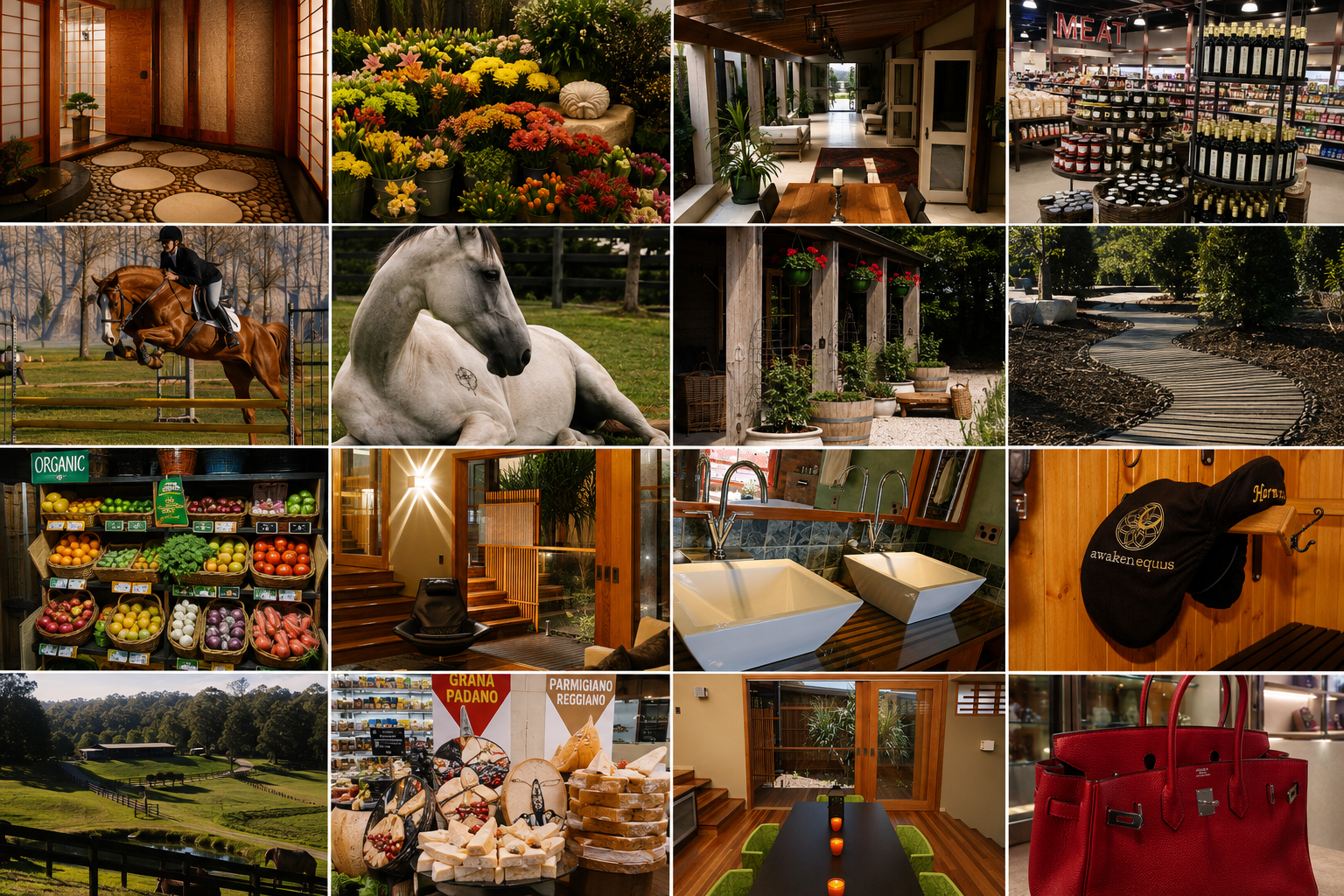
A philosophy has little value if it exists only in books; its true measure is found in the choices we make, the places we create, the relationships we nurture, and the lives we quietly shape over time. For me, A Way of Seeing was never something I invented. Long before it had a name, it was already guiding my decisions. It shaped the homes I designed, the gardens I walked through, the horses I lived beside, and the businesses I created. It influenced the objects I collected, the books I returned to, the places where I found peace, and the environments that felt deeply alive.
Looking back, I can now see that every chapter of my life was exploring the same question: What creates belonging? Sometimes the answer revealed itself in architecture, sometimes through the careful arrangement of a room, sometimes while observing the quiet intelligence of a horse, or in the rhythm of a market overflowing with seasonal produce. It could be found in a handcrafted object that carried the story of the person who made it, or in the way morning light entered a room, or simply in the feeling of arriving somewhere that felt right.
Over the years, my work has taken many forms: environmental design, biophilic living, interior design, retail, writing, astrology, and private advisory. To an outside observer, they may appear unrelated. To me, they have always been expressions of the same philosophy. Each moment has asked me to understand relationships before seeking solutions—the relationships between people and place, between beauty and function, between memory and belonging, between the environment and our wellbeing, and between the inner life and the worlds we shape around ourselves.
I have never been drawn to decoration for its own sake, nor to collecting experiences simply because they were beautiful. Beauty only becomes meaningful when it deepens connection. A home designed with thought can create calm. A single, carefully chosen object can hold a memory. A flourishing garden can restore perspective. A horse can teach trust without ever speaking a word. A market can quietly reveal the values of a community. Every place tells a story; every object carries intention; every relationship leaves its imprint. These are not separate moments—they form a way of seeing the world.
The images that follow are not a portfolio. They are fragments of a life lived as an ongoing conversation with this philosophy—moments gathered over years, across many disciplines. Some are quiet. Some are deeply personal. Some mark significant projects. Others simply capture the ordinary made extraordinary. Together, they tell one continuous story—not of what I have accomplished, but of how I have learned to see. Because philosophy is only ever understood when it becomes practice. And practice, repeated gently and with care, becomes the life itself.
Click “Read Essay” to expand the full essay below. Only one essay is open at a time.
04: A Philosophy in Practice
A philosophy has little value if it exists only in books.
Its true measure is found in the choices we make,
the places we create, the relationships we nurture
and the lives we quietly shape over time.
The images that follow are fragments of a life lived
in conversation with this philosophy.
They are moments gathered across many years
and many disciplines.
Together they tell one continuous story.
Not of what I have done,
but of how I have learned to see.
Full essay above the grid
-
How the philosophy began.
-
How it evolved through design, writing, astrology and advisory.
-
Exactly what biophilic living is and why it matters.
-
The philosophy recognised through meaningful work, including the FIABCI World Prix d’Excellence Award.
-
How Delahrose expresses this philosophy today.
This Soul Session with you was Excellent! Thank you so much. I loved every second of our call.
You'll see me again soon.
It was a gift in every sense of the word to have received your intuition and immense talents.
I awoke today so much more lifted and hopeful, knowing other people speak this language and know what I'm talking about.
You are a treasure, and I can't put into words the value you have brought to me.
I’ll probably listen to it several times and write it all out as well.
MOLLY
USA

“
”
OBSERVATIONS
01
Nothing of meaning is built in a hurry. It is the slow accumulation of attention.
02
Beauty is not created. It is revealed when everything unnecessary is removed.
03
The spaces we inhabit shape the lives we are able to live.
04
Listening is the first act of creating something meaningful.
05
A good life is not measured by what we own but by what we nurture.
06
A way of seeing shifts the decisions we make and the legacy we leave behind.
PRIVATE ADVISORY
Perspective. Clarity. Direction.
Private advisory is where the philosophy becomes a personal conversation.
I work with individuals who are seeking clarity, direction and meaningful change across every area of their life.
Enquire About Private Advisory >
Conversations may explore:
✧ Life transitions and reinvention
✧ Home, property and relocation
✧ Business and creative direction
✧ Relationships between people and place
✧ Long-term vision and decision-making
✧ Personal clarity and meaningful change