When Insight Becomes Avoidance: On Walking Away from the Spiritual Industry
When Insight Becomes Avoidance
On Walking Away from the Spiritual Industry
This poem was the first thing I wrote. It was not written for publication. It was written for me — at the beginning of a passage I could not yet see the end of. I include it here because it is where everything that follows began.
TIME …
Time to heal long-buried pain,
Time to think, to feel again.
Time to reflect, to slowly learn,
Time for grief, and then return.
Time to adjust, to deeply connect,
Time to really self-inspect.
Time to walk, to breathe the air,
Time to meditate with care.
Time to study, to speak, to write,
Time to be angry and ignite the fight.
Time to dig deep, peel every layer,
Time to find peace, a silent prayer.
Time to see where blocks have grown,
Time to face the pain unknown.
Time to heal the victim’s plea,
Time to see the “Not Self” in me.
Time to look within, to explore,
Time to find what makes me soar.
Time for the heart to finally mend,
Time for love to bloom again.
Time to see with grateful eyes,
The beauty in life’s quiet skies.
There is a growing conversation right now about people feeling disenchanted with the spiritual space. Fatigue with the language. Fatigue with the repetition. Fatigue with the sense that something is being said but not lived.
I understand that.
But my experience of this didn’t begin recently. I walked away from it years ago. Not out of rejection. Out of recognition.
There comes a point where you begin to notice that the same phrases are being repeated in different voices, and yet the lives of the people repeating them do not always reflect the depth of what is being spoken.
Trust the universe. Raise your vibration. Shift timelines.
Words that sound meaningful, but over time begin to feel unanchored — not because the ideas themselves are false, but because they are so often used without embodiment. And that is where something inside you starts to withdraw.
Because truth does not need repetition to hold weight. It carries itself.
What I began to see very clearly was that much of what is called growth can function as a very refined form of avoidance. Insight replacing action. Language replacing experience. Awareness standing in for actual change. The spiritual industry has become extraordinarily skilled at producing the feeling of progress without requiring its cost.
I say this not from observation alone. I say this from having lived through a period when avoidance was no longer an option for me.
There are phases in life where you can explore, question, consume, and expand. And then there are phases when life strips away everything you were using to orient yourself.
For me, that meant facing the ultimate betrayal by the most trusted — leading to the loss of a home, horses I loved with a loyalty that is hard to put into words, a professional world I spent fifteen years building, material security, and the identity I had crafted around all of it.
It meant three years inside a legal battle I never initiated, which wore me down and cost me more than money.
It meant illness and multiple surgeries in the middle of that.
It meant confronting the particular shame of a woman who had once been recognised in her field, then seemingly overnight becoming invisible.
What remained after all of that was not a concept. It was the raw experience of myself with nothing external left to hold me together.
And that space cannot be navigated through podcasts, teachings, or anyone else’s framework. It cannot be bypassed with platitudes or borrowed phrases spoken at you. It requires time. Grief. Stillness that is not chosen but imposed. A willingness to sit with what is actually there rather than what you wish were there instead.
That was the passage that shaped me. And it is why I no longer look to external frameworks to define truth. Because I learned, at a cost I would never have chosen, that no amount of guidance can replace direct experience.
No insight, however precise, can substitute for the thing itself.
This is also why I chose to write Fatima’s Alchemy the way I did — not as instruction, not as influence, but as symbolic reflection. I wrote it in silence, without an audience, without a trend to position it within, without validation from any circle of approval. Four years of writing. A fifth of refinement. Because the work itself had to be true before it could be anything else.
And from that came something I could not have arrived at any other way — a way of seeing beneath surface narratives, of recognising pattern, of understanding that people do not need more direction. They need the capacity to see clearly for themselves.
The spiritual industry is particularly dangerous in this regard because it trades in the language of interiority while functioning as another form of consumption. It can keep you endlessly adjacent to yourself — close enough to feel like growth, far enough to avoid the encounter that would actually change you.
The encounter that changes you is not comfortable. It does not arrive as an expansion. It arrives as a dismantling. And it cannot be prepared for, packaged, or taught. It can only be lived.
What I did not expect, in the middle of all of it, was the particular quality of the silence I encountered from that world.
Not cruelty. Something quieter and in its own way more disorienting — a kind of managed compassion, shaped to the edges of what was comfortable for the person offering it. Words that asked for authenticity but could not receive it. Language that professed depth but had no ground beneath it when the weight was real.
I was not met. I was processed.
What became clear, slowly and then completely, was that the safety being offered was conditional. The invitation to be fully seen was genuine only within certain limits — limits that served the container, not the person inside it. When what I brought exceeded those limits, the response was not presence. It was bypassing. A reframe. A redirection toward something more manageable.
Are you still talking about that? You need to let it go. Drop the story.
Platitudes recited with confidence by people who had never been anywhere near the terrain they were describing. You could feel it. Not as judgment — as a kind of hollow echo where substance should have been. The words were correct. The ground beneath them was not there.
And this is where I want to be precise, because it matters beyond my own experience.
When things truly fall apart — not as a concept, not as a growth opportunity, but as the actual collapse of everything you built and trusted — where do people go? If the world that speaks most loudly about being seen cannot hold substance when substance is required, then people in genuine crisis are navigating the hardest terrain of their lives without real ground beneath them.
What I needed — what I believe most people need in those moments — was not direction. Not a framework. Not someone guiding me toward their interpretation of what my experience meant. I needed the rarer thing. To be witnessed without agenda. To have enough safety to see my own patterns clearly, in my own time, without the implicit pressure to arrive at someone else’s conclusion. To be allowed to adopt nothing except myself, fully and without condition.
There is a particular quality to that kind of presence. It does not try to move you along. It does not flinch at the repetition of grief, or grow impatient with the circling, or need the conversation to resolve into something it can feel comfortable with. It simply stays. It knows that what sounds like the same story being told again is often the same wound being turned in the light until the person can finally see it clearly for themselves. It knows that real witnessing requires you to let someone be exactly where they are — not where you need them to be for your own comfort.
That quality cannot be taught from a book or a training. It can only come from having been through something that cost you everything and having stayed present with yourself through it. You cannot offer a depth you have not lived.
What the spiritual industry offers instead is the performance of that presence. And for someone in genuine collapse, the gap between the performance and the real thing is not a minor disappointment. It is a second abandonment arriving in the guise of help. The original wound, and then the wound of having reached toward something and found it hollow.
Add to that the gossip. The quiet judgement. The opinion circulating about your life from people who had never walked a day inside it. That is its own particular damage — the guilt and the remorse of knowing that your most exposed moments were being processed as content for someone else’s narrative about you.
To truly heal, to truly mourn something, you must be able to witness it in its entirety. Not mask it. Not shape it for the comfort of the room. That shaping is still a suppression — and the spiritual world speaks against suppression while practising it constantly, just in more elevated language.
What people need in those moments is closer to what a good sponsor offers someone in recovery. Not someone who holds you to every word you say in the darkest hour, but someone who understands that what is being spoken is pain expelling itself. The unravelling. Someone who can receive it without being destabilised by it, without needing to redirect it, without making you feel that your grief is an inconvenience to their equilibrium.
Someone who can let you find ground. Just enough ground to take the next breath. The next step. Not scrambling on terrain that keeps shifting underneath you, but enough stillness to locate yourself again.
That is not a complex thing to offer. But it requires something the spiritual industry rarely demands of itself — the discipline of genuine presence over performed wisdom.
I have not attended spiritual groups or engaged with that world for years. Something in me changed. Not in judgment. In self-respect.
Because I had already been taken through something that showed me, very clearly, what real transformation requires. It does not come through being told what you want to hear. It does not come through being guided toward a feeling. It comes through living. Through consequence. Through seeing your own patterns clearly enough that you can no longer avoid them.
What I look for now is simple. It must hold against what I have lived. It must be consistent in the body. It must be coherent with experience, not just language.
Where I sit now, I don’t feel disillusioned. I feel clear.
I don’t write to lead a following. I write to hold a lantern. So that others might pause, look more closely, and begin to question what they are being told alongside what they already know.
Because the moment you begin to see clearly, you realise something simple: nothing you are looking for is missing.
After writing this essay, I opened Fatima’s Alchemy at random — something I love to do. She speaks as an oracle, which is always a precise and quietly astonishing experience.
This is what I encountered: Story #78, The Golden Thread.
A story about what is not lost, only unseen. About calling back what was always yours. About weaving a life from lived truth, not borrowed language.
It felt exact.
Because this is what I have come to understand: you are not here to be given direction. You are here to recognise what is already in your hands.
And decide what you will weave with it.
What strikes me, standing here on the other side of everything I have lived, is not bitterness. It is a kind of wondering. We are a world that has named what it needs with great eloquence and then built every possible structure around it except the one that would actually work. We know the language of wholeness. We do not yet know how to provide the ground for it. Perhaps we are still learning. Perhaps some of us are further along than others — not because we found the right path, but because the wrong ones were taken from us before we could settle for them. I do not know what the world will find. I know what I found. And it did not come from being guided. It came from being left, finally, with only myself — and discovering that was always enough.
You become what you wished you had found.
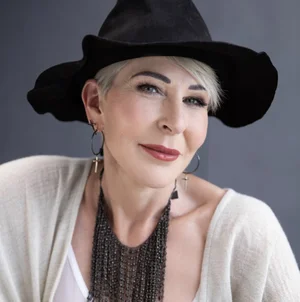
Delahrose Roobie Myer
Confidante · Catalyst · Clarifier
Author, Fatima’s Alchemy: A Treasure to Behold